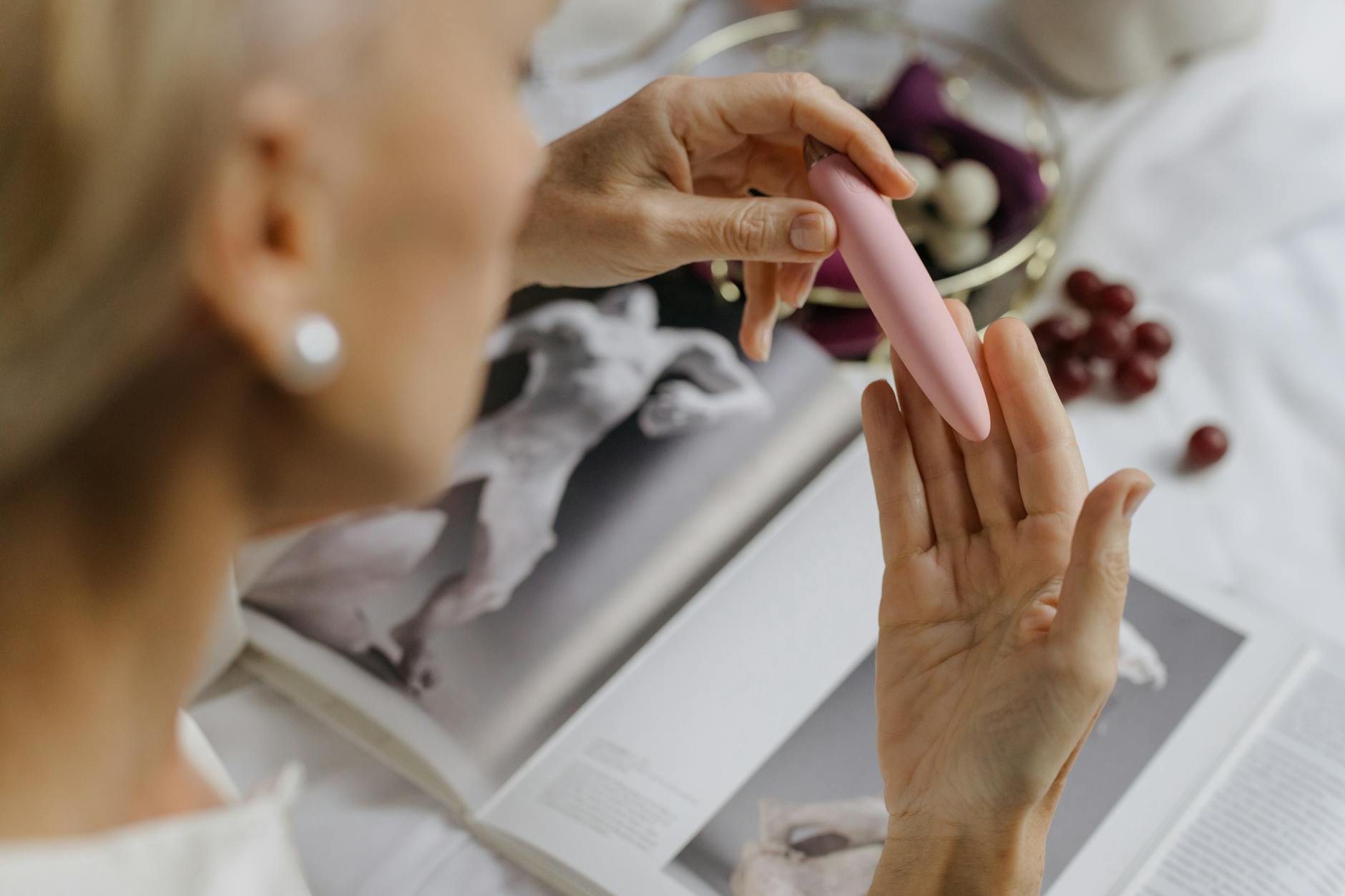
Let's start by getting this straight
Having a partner and wanting solo pleasure aren't contradictory. They're adjacent needs. Yet so many people treat solo vibrator use as something to hide, apologize for, or feel guilty about the moment they enter a relationship. That's not actually about the vibrator. That's about messaging you absorbed somewhere that your pleasure belongs to your partner, or that wanting it alone means something's broken.
It doesn't.
Solo pleasure with a lemon vibrator while in a relationship is about three things: maintaining your own arousal capacity, knowing your body independent of someone else's rhythm, and preserving the part of you that belongs entirely to you. All of that makes you a better partner, not a worse one.
Why solo pleasure gets complicated in partnerships
When you're coupled, pleasure becomes relational. Sex with a partner requires negotiation, timing, communication, and compromise. That's not bad. It's just... not the same as the conversation between you and your own body.
Three shifts happen when you partner up:
1. Obligation creeps in. When your partner is involved, there's a psychological weight to pleasure. You might worry about their arousal, their satisfaction, their feelings. Solo pleasure has none of that. It's pure feedback from your own nervous system.
2. Timing gets complicated. Your partner might not be available when arousal hits. They might be tired, stressed, traveling, or just not in the mood. Solo pleasure with a lemon clitoral vibrator solves that immediately. You don't wait for permission or alignment.
3. You might stop knowing yourself. This one's sneaky. When you habitually have partnered sex and rarely explore alone, you can lose track of what you actually like independent of what works with them. Your body's baseline pleasure response drifts. Then partnered sex feels flat because you've accidentally trained yourself to need their presence to feel anything at all.
The case for keeping solo pleasure alive
Research on long-term relationships is clear: couples who maintain independent sexual autonomy report higher satisfaction in partnered sex. Not lower. This isn't about choosing yourself over your partner. It's about keeping yourself intact so you have more to bring to the partnership.
Think of it like professional development. If you only ever worked within one company, never learned new skills alone, never explored your own interests independently, you'd become less valuable to that company, not more. Same principle.
Using lemon vibrators solo also maintains your arousal plasticity. If your body only ever responds to one specific rhythm (your partner's preferred stimulation), it becomes less responsive overall. Variety in solo pleasure means your nervous system stays adaptive. That flexibility translates directly into better partnered sex.
How to use lemon vibrators for solo pleasure without guilt
First, separate the logistics from the emotion. Logistics: where, when, how you access solo time and how you clean up. Emotion: the story you're telling yourself about what it means.
Timing is easiest. Early morning before your partner wakes. Lunch break if you're working from home. Evening after they've gone to bed. Weekends when they're out. Solo pleasure doesn't require elaborate planning, just small windows of privacy.
Finding privacy. If you share space, a locked bathroom works. Five to fifteen minutes of vibrator use is realistic, not a production. Lemon vibrators are quiet enough that volume isn't usually the problem. It's more about uninterrupted headspace.
The actual use. This is where solo pleasure differs from partnered play. You're not performing. You're not managing anyone else's experience. You can:
- Take your actual time building arousal, not rushing to a partner's readiness
- Explore sensation without worrying if it looks or feels "right"
- Stop whenever you want without negotiation
- Orgasm once and be done, or edge for thirty minutes, or not orgasm at all
- Use fantasy, porn, or just your own thoughts without explaining or justifying
With a lemon clitoral vibrator, you can start at lower intensity and work up. You can switch patterns mid-session. You can focus on clitoral sensation alone, which is entirely different from the full-body experience partnered sex might include.
When (and how) to talk to your partner about it
Here's the thing: you don't owe your partner a detailed report of your solo pleasure. That's not transparency. That's performance. But if you're sneaking around or feeling shame, that usually means you haven't had the actual conversation.
The conversation isn't "I want to use a vibrator alone sometimes." That frames it as a request for permission you don't need. Instead: "I've realized solo pleasure is important to me for keeping my own arousal alive. It's not about you or us. It's about me maintaining my own baseline."
If your partner pushes back, get curious about what's underneath. Often it's not really about the vibrator. It might be:
- Insecurity that you're attracted to someone else (you're not, it's just you and a toy)
- Worry that they're not enough (solo pleasure isn't comparative)
- Cultural baggage about "proper" sexuality (same as yours, probably)
- Fear that partnership means merging into one person (it doesn't)
Your job is to hear that without taking it on. You can say, "I understand that's uncomfortable. I'm still doing this because it matters to me."
Solo pleasure and arousal capacity
One of the sneakier benefits of regular solo pleasure with lemon vibrators is that it keeps your clitoral sensitivity calibrated. If you only ever have partnered sex, your baseline can shift to match that specific stimulation. Then when you're solo, nothing feels quite right. Or worse, when your partner's away or rhythm changes, you can't access arousal at all.
Solo play rewires that. It tells your nervous system, "Your pleasure doesn't depend on another person." That's not cold or selfish. That's resilience. That's keeping yourself intact.
If you've been in a relationship for years and haven't explored solo pleasure in a while, expect an adjustment period. Your body might feel less responsive initially. That's normal. You're relearning your own baseline. Give it a few weeks of regular exploration and sensation usually comes back online.
What happens to your partnered sex
Countintuitively, more solo pleasure usually improves partnership sex. Here's why:
- You stop resenting your partner for not being available exactly when you want them
- You know what you actually like, so communication during partnered sex gets sharper
- You're less desperate during sex, which takes pressure off your partner
- Your body stays responsive, so partnered stimulation actually lands better
- You come to sex because you want to, not because you need them to fix your arousal
It's a paradox but a real one. The more independent your pleasure is, the more satisfying the shared version becomes.
FAQ
Is using a lemon vibrator alone while partnered considered cheating?
No. Solo pleasure with a toy is not infidelity. Cheating involves deception and betrayal of trust within the specific agreements you've made with your partner. Solo pleasure is about you and your own body. If that feels like a betrayal to your partner, that's a conversation about what exclusivity actually means to them, not a verdict on whether solo pleasure is wrong.
My partner feels threatened by my solo vibrator use. What do I do?
First, you can invite them to understand it. Sometimes watching or being present during solo pleasure helps. Sometimes the answer is just reassurance and time. But also: you don't have to perform pleasure for their comfort. If they're genuinely upset that you're exploring your own body independently, that's worth examining as a relationship pattern. You deserve autonomy. Period.
How often should I use lemon vibrators solo?
There's no "right" frequency. Some people enjoy solo pleasure a few times a week. Others prefer monthly. What matters is that it feels sustainable and genuinely pleasurable, not like another obligation. If you're doing it to avoid partnered sex or to punish someone, that's different. If you're doing it because your body likes it, do it as often as that's true.
Can solo pleasure with vibrators affect my ability to orgasm with a partner?
It can, if you use it as a replacement for partnered sex or if the intensity is so high that partnered stimulation feels underwhelming by comparison. But most people find the opposite: regular solo exploration makes partnered sex better because they know themselves. Vary your intensity during solo play. Sometimes go slow. Sometimes use lower settings. Keep your nervous system adaptable.
Should I hide my vibrators from my partner?
Hiding usually signals shame, which eventually leaks out as resentment or distance. That said, privacy and discretion aren't the same as hiding. You don't need to leave lemon vibrators on the nightstand if that creates tension. But storing them somewhere secure and accessible is reasonable. The hiding that becomes a problem is the sneaking, the lying about what you're doing, the compartmentalization. That erodes trust.
What if my partner wants to watch or join?
You get to decide. Solo pleasure is yours. If you want to include them sometimes, great. If you prefer it stays just for you, that's equally valid. "I like having some pleasure that's just mine" is a complete sentence. Boundaries around your body aren't rejection of your partner. They're respect for yourself.
The real thing
Your partnership doesn't require you to merge into one person with one pleasure response. You can be deeply connected to your partner and deeply committed to your own solo arousal. Those aren't opposing forces. They're both part of a full life.
Using lemon vibrators solo while in a relationship isn't a compromise or a consolation prize. It's maintenance. It's self-knowledge. It's the foundation that makes partnered pleasure actually work.
If you want to explore different sensation types with clitoral vibrators, solo time is the perfect laboratory. And if communication with your partner around pleasure feels stalled, that earlier conversation about introducing vibrators early in dating often has useful frameworks.
Your pleasure matters. Solo and partnered. Both true at once.